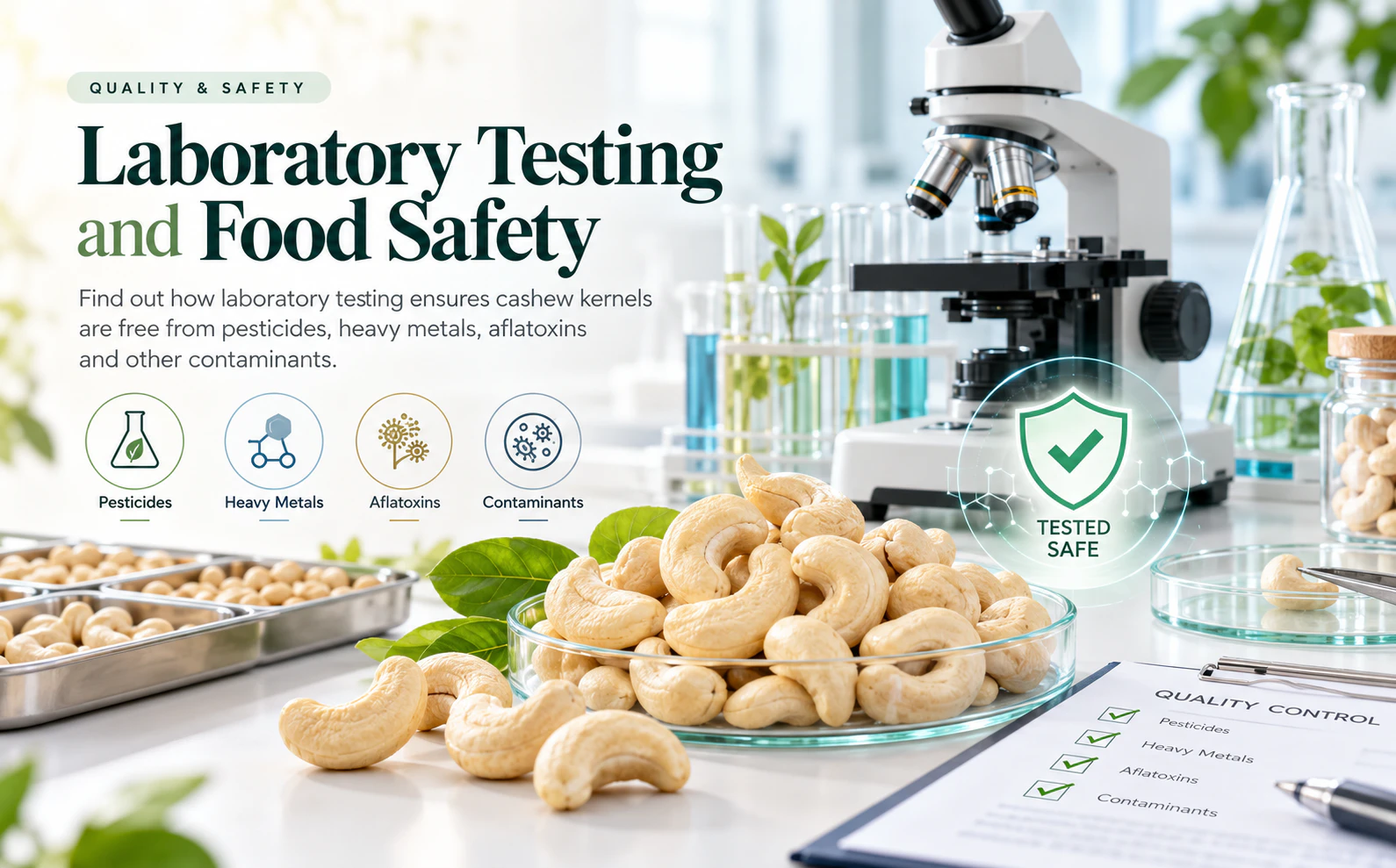
Laboratory testing plays an important role in maintaining the quality and safety of cashew kernels before they reach consumers or commercial buyers. Testing can help identify unwanted contaminants, verify important quality parameters and confirm whether products meet specific customer or market requirements before packing and distribution.
Cashew kernels may be tested for pesticide residues, heavy metals, aflatoxins, microbiological contamination, moisture and other quality indicators. These tests provide additional assurance beyond visual inspection and help food businesses maintain consistent standards across different production batches.
Cashew kernels pass through several stages including sourcing, steaming, shelling, drying, peeling, grading, packing and storage. At each stage, proper handling is necessary to protect product quality. Laboratory testing adds another level of verification by checking characteristics that may not be visible during normal inspection.
Quality teams can use test results to evaluate whether a batch meets agreed specifications before it is supplied to customers. This is especially important for export markets, food manufacturers and buyers who require documented evidence of product quality and food-safety compliance.
Pesticide residue testing is used to check whether traces of agricultural chemicals are present in cashew kernels. Raw cashew nuts may be exposed to agricultural treatments during cultivation, so testing can help determine whether residue levels comply with applicable food-safety requirements and customer specifications.
Laboratories may analyse cashew samples for different groups of pesticide compounds depending on destination-market requirements. These tests help exporters and processors identify unsuitable batches and support compliance with maximum residue limits where applicable. Maintaining good agricultural and sourcing practices can also reduce potential residue risks.
Heavy metals are another group of contaminants that may be monitored in food products. Elements such as lead, cadmium, arsenic and mercury may be included in testing programmes depending on regulatory or customer requirements. Their presence can be influenced by soil, water, environmental conditions and handling practices.
Laboratory analysis can measure the concentration of selected metals and compare the results with applicable specifications. Regular monitoring helps food businesses understand potential risks in raw materials and finished products while supporting stronger quality-control systems throughout the supply chain.
Aflatoxins are naturally occurring toxins produced by certain moulds under favourable environmental conditions. Because nuts can be sensitive to moisture and storage conditions, aflatoxin monitoring may form an important part of food-safety testing for cashew products.
Proper drying, moisture control and storage help reduce conditions that encourage mould development. Laboratory testing provides an additional verification step by checking whether aflatoxin levels are within applicable requirements before cashews are released for commercial distribution.
Microbiological testing is used to assess whether food products contain unwanted microorganisms. Depending on the required test plan, laboratories may analyse cashew kernels for indicators such as total microbial count, yeast, mould and selected pathogenic microorganisms.
These tests are particularly useful for evaluating the effectiveness of hygiene, sanitation, processing and storage practices. Clean facilities, proper employee hygiene, controlled handling and suitable packaging all contribute to reducing microbiological risks in finished cashew kernels.
Moisture content is an important quality parameter for cashew kernels. Excessive moisture can affect texture, storage stability and overall product condition, while extremely low moisture may make kernels more brittle and increase the possibility of breakage during handling and transportation.
Laboratory or in-house moisture testing allows processors to verify whether kernels are within the desired range before packaging. Proper drying, conditioning and storage help maintain suitable moisture levels and support consistent quality across different batches.
Foreign matter refers to unwanted materials that may accidentally enter a food product during processing or handling. Quality-control systems are designed to prevent contamination from shell fragments, dust, packaging materials or other non-food substances.
Visual inspection, sieving, sorting and laboratory examination can help identify foreign material in cashew kernels. Good manufacturing practices and clean production environments are essential for reducing this risk before the product reaches the final packing stage.
Metal detection is another important control used in modern food-processing facilities. Cashew kernels may pass through metal-detection equipment before final packaging to identify unwanted metallic particles that could enter during machinery operation or handling.
The equipment is typically positioned at suitable stages of the production line and checked regularly to ensure reliable operation. Metal detection works together with other preventive controls to strengthen the overall food-safety system.
Laboratory and quality-control checks are not limited only to chemical or microbiological parameters. Physical characteristics such as kernel size, colour, shape, breakage and visible defects may also be examined to confirm the commercial quality of a batch.
These checks are particularly important when supplying specific cashew grades such as W210, W240, W320, W450, splits and other classifications. Accurate inspection helps ensure that the packed product matches the grade and quality expected by the customer.
Sensory evaluation may be used to assess characteristics such as appearance, aroma, taste and texture. Even when laboratory values meet required specifications, the final product should still have acceptable sensory qualities for its intended market.
Trained quality teams may inspect sample kernels from each batch to check freshness and consistency. Unusual odours, flavour changes or undesirable texture can indicate storage or handling problems that require further investigation.
Accurate laboratory testing begins with proper sample collection. A sample should represent the larger batch as closely as possible so that test results provide meaningful information. Poor sampling can lead to results that do not accurately reflect the overall product.
Sampling procedures may include collecting kernels from different bags, cartons or areas within a batch. The samples are then combined or handled according to the selected testing procedure before being sent to the laboratory.
Food safety starts before the cashew kernel is fully processed. Raw cashew nuts can be evaluated for condition, moisture, storage quality and other relevant characteristics before entering production. Early checks help processors identify potential problems before additional processing takes place.
Supplier assessment and raw-material inspection can also support traceability and consistency. By monitoring incoming materials, processors can maintain stronger control over the quality of the finished kernels and reduce the possibility of unsuitable raw materials entering production.
Laboratory testing works best when combined with strong hygiene practices throughout the processing facility. Equipment, work surfaces, storage areas and employee handling procedures should be managed carefully to reduce contamination risks.
Facilities may use cleaning schedules, sanitation records, pest-control systems and employee hygiene programmes. Environmental or surface testing may also be used where appropriate to verify that cleaning and sanitation practices are working effectively.
Good Manufacturing Practices help create a structured environment for producing safe and consistent food products. These practices cover areas such as employee hygiene, facility cleanliness, equipment maintenance, storage, documentation and contamination prevention.
Laboratory testing complements these practices by providing measurable evidence about product quality. Testing alone cannot replace good manufacturing controls, so both preventive practices and verification activities should work together within the quality-management system.
Proper storage plays a major role in maintaining cashew quality after processing. Finished kernels should be kept in clean, dry environments protected from excessive heat, moisture, pests, strong odours and other possible sources of contamination.
Storage conditions can influence moisture levels, freshness and microbial stability. Regular warehouse inspections, correct stock rotation and suitable packaging help preserve quality while reducing risks during the period between production and final delivery.
Food-grade packaging helps protect cashew kernels after processing and laboratory verification. Packaging should reduce exposure to moisture, air, dust and environmental contamination while also protecting kernels from physical damage during transportation.
Vacuum or controlled packaging methods may be used depending on customer and market requirements. Proper sealing is important because damaged or poorly closed packaging can reduce the protection provided to the finished product during storage and shipment.
Export cashew shipments may require additional testing depending on the destination country, buyer specifications and applicable regulatory requirements. Tests can include pesticide residues, aflatoxins, microbiological parameters, heavy metals, moisture and other agreed quality characteristics.
Exporters should confirm the exact requirements of the destination market before shipment because standards can vary between countries and customers. Testing against the correct specification helps reduce the risk of delays, rejection or non-compliance during international trade.
Testing is most useful when it is carried out using recognised methods and properly controlled laboratory procedures. Accredited or appropriately qualified laboratories can provide greater confidence in the accuracy, consistency and traceability of analytical results.
Laboratory reports should clearly identify the tested sample, analytical method, result and relevant units. Proper documentation makes it easier for suppliers and customers to review the findings and confirm that agreed quality requirements have been met.
Batch identification helps connect laboratory results with specific quantities of cashew kernels. Each production batch can be assigned a code that links processing, inspection, packaging and testing information together for easier traceability.
If a quality concern is later identified, good traceability makes it easier to determine which batches may be affected. This supports faster investigation, corrective action and communication with customers when necessary.
Laboratory test reports form an important part of product quality documentation. Reports can provide information about the tested parameter, measured result, method used and other relevant analytical details.
Buyers may request certificates or test reports before accepting commercial shipments. Maintaining organised records can therefore improve transparency and make communication between processors, exporters, importers and food manufacturers more efficient.
Cashews intended for retail sale require the same attention to processing, hygiene, packaging and storage as commercial bulk products. Finished kernels should be handled carefully from production until they reach the consumer.
Retail packaging should protect the product while providing suitable information such as batch identification and other required labelling details. Proper storage by distributors and retailers also helps maintain product quality throughout the supply chain.
Bakeries, confectionery manufacturers, snack companies and other food businesses may use cashews as an ingredient in large-scale production. These buyers often require consistent quality and may set specific microbiological, chemical and physical specifications.
Laboratory testing helps suppliers demonstrate that their cashew kernels meet the agreed requirements before delivery. Clear specifications and regular communication between supplier and customer help reduce quality variations and support efficient production.
Cross-contamination can occur when food products come into contact with unwanted substances, allergens, microorganisms or materials from other production activities. Processing facilities should manage product flow, equipment and employee movement carefully.
Cleaning procedures, controlled storage, dedicated equipment where necessary and proper employee training can help reduce cross-contamination risks. Laboratory verification may also be used as part of a broader preventive food-safety programme.
Food safety should not depend on a single test performed only at the end of production. Regular monitoring throughout sourcing, processing, storage and packing provides better control over potential quality issues.
Processors can review test results over time to identify trends or recurring concerns. This information can support improvements in supplier selection, processing conditions, cleaning procedures and storage practices.
Consistent laboratory testing can strengthen confidence between suppliers and buyers by providing objective information about product quality and safety. It helps confirm that specified parameters have been checked rather than relying only on visual appearance.
This is particularly valuable for international buyers, professional food manufacturers and businesses purchasing cashews in large quantities. Reliable testing, documentation and traceability can make commercial relationships more transparent and dependable.
Maintaining safe cashew kernels requires a combination of proper sourcing, controlled processing, hygiene, moisture management, storage, packaging and laboratory testing. Each control addresses a different potential risk within the production and distribution process.
Laboratory testing should therefore be viewed as one part of a complete quality-management system. Preventive controls reduce the likelihood of problems, while testing helps verify that finished products meet established quality and food-safety requirements.
Laboratory testing is an important tool for verifying the quality and safety of cashew kernels. Tests for pesticide residues, heavy metals, aflatoxins, microorganisms, moisture and other parameters can help identify risks that may not be visible during normal inspection.
When laboratory testing is combined with hygienic processing, good manufacturing practices, proper storage, suitable packaging and reliable traceability, it creates a stronger food-safety system. These controls help ensure that cashew kernels supplied to retail, export and food-manufacturing markets meet expected quality standards.