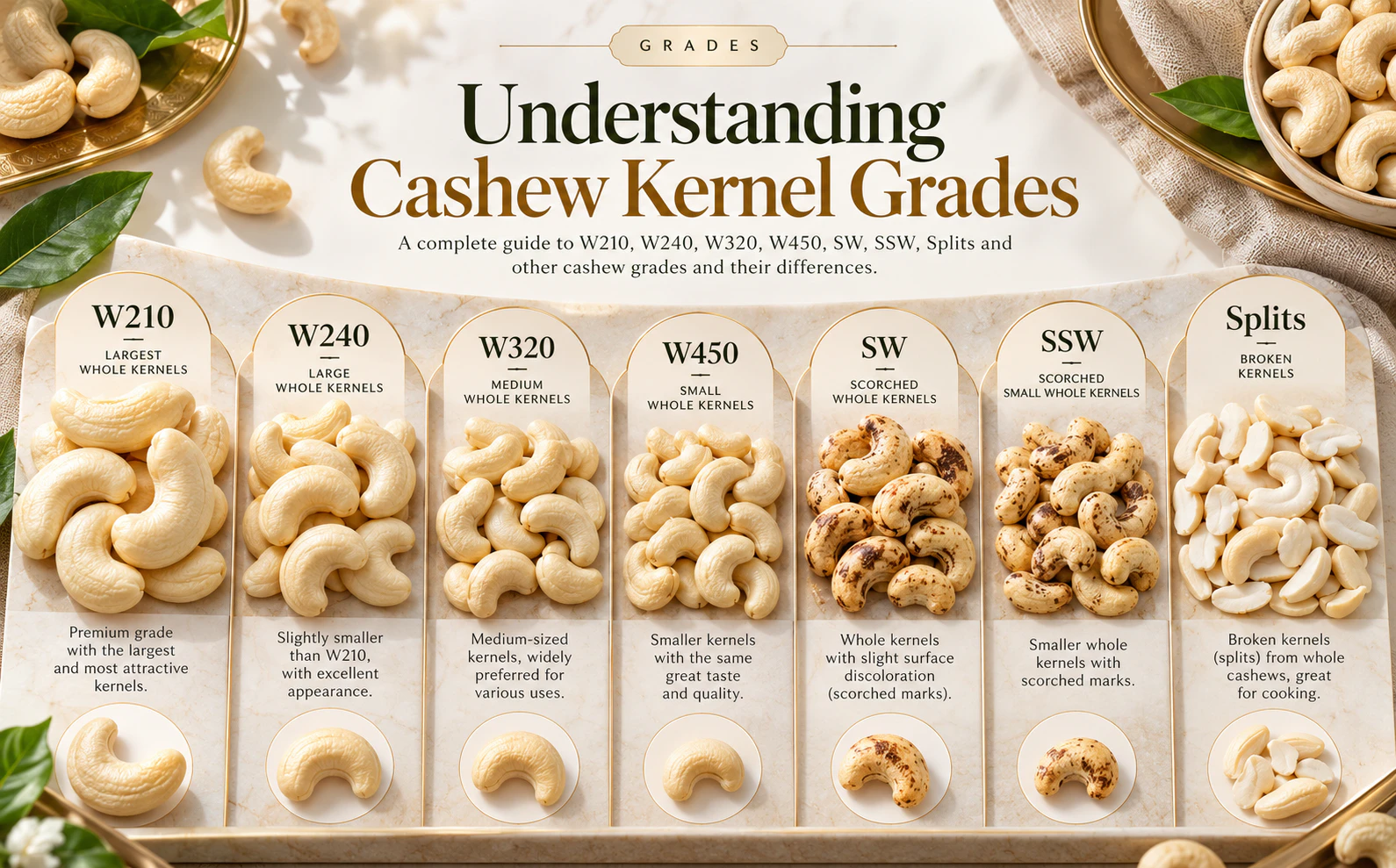
Cashew kernels are available in many commercial grades based on their size, shape, colour and level of breakage. Grades such as W210, W240, W320, W450, SW, SSW and Splits help buyers understand the physical characteristics of the kernels before purchasing. Each grade serves different retail, food-service and manufacturing requirements.
Understanding cashew grading is important for importers, wholesalers, retailers, bakeries, confectionery manufacturers and food processors. The grade does not simply indicate whether one cashew is better than another; instead, it helps classify kernels according to appearance, size and intended commercial use.
Cashew kernel grades are classifications used to separate processed cashews according to specific physical characteristics. Whole kernels are commonly grouped according to size and colour, while broken kernels are classified as splits, butts or pieces. This system helps create consistency across commercial cashew trading.
The grading process usually takes place after shelling, drying and peeling. Kernels are inspected and separated according to their appearance and dimensions. Accurate grading allows buyers to select the most suitable cashew type for snacking, retail packing, sweets, bakery products, confectionery and industrial food production.
The letter “W” used in grades such as W210, W240 and W320 generally refers to whole kernels. These cashews remain largely intact after processing and have not been split into smaller pieces. Whole kernels are often preferred for premium presentation, retail packaging and direct consumption.
The number that follows the letter W is related to the approximate kernel count within a standard weight range. Lower numbers generally indicate larger kernels, while higher numbers represent smaller whole kernels. This makes the grading system useful for comparing the visual size of different cashew products.
W210 is considered one of the larger commercially available whole cashew grades. The kernels are visually large, attractive and commonly selected for premium retail products, luxury gift packs and direct snacking. Their larger appearance often gives them a premium presentation compared with smaller whole grades.
Because W210 kernels require a larger kernel size, they are generally available in more limited quantities than common grades such as W320. They are often chosen when appearance and presentation are important. Premium hotels, specialty retailers and gifting businesses may prefer larger kernels for high-value products.
W240 is another premium whole cashew grade that provides a good balance between large kernel size and commercial availability. The kernels are slightly smaller than W210 but still have an attractive, substantial appearance. They are widely suitable for premium snacking, retail packaging and food-service applications.
W240 cashews can be used in gift boxes, mixed nuts, premium sweets and high-quality snack packs. Their consistent whole shape makes them visually appealing while their size remains practical for many commercial applications. They are often selected by buyers looking for a premium grade without moving to the largest size category.
W320 is one of the most widely traded and commonly recognised cashew grades in the international market. These whole kernels offer a balanced combination of size, appearance, availability and cost. Because of this versatility, W320 cashews are used across retail, wholesale and food-manufacturing applications.
W320 kernels are commonly sold as roasted snacks, flavoured cashews, retail packs and mixed-nut products. They can also be used in bakery items, confectionery and cooking. Their practical size and broad availability make W320 one of the preferred grades for many commercial buyers.
W450 kernels are smaller whole cashews compared with W210, W240 and W320. Although smaller in size, they retain the natural flavour and basic nutritional characteristics associated with cashew kernels. Their smaller appearance can make them more economical for certain retail and food-production requirements.
W450 cashews can be used for direct consumption, cooking, sweets, bakery items and mixed-nut preparations. They are especially useful when whole-kernel appearance is required but a larger premium size is not necessary. This makes them suitable for value-focused commercial applications.
The main difference between W210, W240, W320 and W450 is the approximate size and count of the whole kernels. W210 kernels are larger, followed by W240 and W320, while W450 represents a smaller whole-kernel grade. The suitable grade depends largely on the buyer's intended use and presentation requirements.
Larger grades are commonly chosen for premium products where appearance is especially important. Medium-sized grades such as W320 offer broad commercial flexibility, while smaller whole grades can provide better cost efficiency. All of these grades can still deliver the natural flavour and texture expected from cashew kernels.
SW generally refers to Scorched Wholes. These are whole cashew kernels that may have a slightly darker or toasted appearance compared with standard white whole kernels. The colour difference can result from processing conditions, particularly during drying or heat exposure.
Although the appearance may differ from premium white kernels, SW cashews can still be suitable for many food applications. They are frequently used in cooking, bakery products, sweets, confectionery and processed foods where a perfectly white appearance is not essential.
SSW generally refers to Scorched Small Wholes or similar smaller scorched whole classifications used in commercial grading. These kernels are smaller whole cashews with a darker appearance than standard white whole kernels. Their natural flavour remains useful across many food-processing applications.
SSW kernels may be selected by bakeries, sweet manufacturers, restaurants and commercial food processors where kernel size and perfect colour are less important than functionality. They can provide a practical option for recipes where cashews are mixed, chopped or cooked with other ingredients.
Cashew Splits are kernels that have separated naturally or during processing into two approximately equal halves. While they do not have the same visual appearance as whole kernels, they retain the characteristic taste, texture and general nutritional properties of cashews.
Splits are widely used in sweets, bakery products, curries, confectionery, desserts and food manufacturing. Since many recipes require cashews to be chopped or mixed with other ingredients, splits can provide excellent practical value without requiring premium whole kernels.
Cashew butts are broken kernel sections that are larger than small pieces but do not retain the complete whole-kernel form. They can be produced naturally during shelling, peeling or handling. Although their appearance is different from whole kernels, they remain useful for many commercial food applications.
Butts are frequently used in bakery products, sweets, chocolates, confectionery and processed foods. They can also be roasted or incorporated into snack mixes where perfect kernel shape is not required. Their lower visual grade can provide greater cost efficiency for industrial users.
Cashew pieces are smaller fragments created when kernels break during processing or are intentionally reduced in size. Pieces may be classified into different categories depending on their dimensions and appearance. They are highly useful in applications where the final product does not require whole kernels.
Bakeries, chocolate manufacturers, sweet producers and food-processing companies often use cashew pieces because they can be mixed directly into products. They provide the natural taste and richness of cashews while reducing the need to purchase premium whole kernels only to chop them during production.
White whole cashews are generally recognised for their clean, pale or cream-coloured appearance. They are carefully processed to maintain kernel colour and whole shape. Different size grades can fall within the white whole category, including W210, W240, W320 and W450.
These grades are widely preferred for premium retail packs, direct snacking and gift products because their uniform appearance creates strong visual appeal. Careful temperature control during processing and proper storage are important for maintaining their desirable natural colour.
Scorched kernels generally have a darker shade than standard white kernels because of greater heat exposure during processing. This colour difference does not automatically mean the kernels are unsuitable for consumption. Instead, it mainly affects their commercial appearance and grade classification.
Scorched cashews can be useful in applications where colour is less important, including bakery items, sweets, sauces and processed foods. Buyers may select these grades when they want functional cashew ingredients without paying for premium visual appearance.
Cashew grades are primarily based on physical characteristics such as size, colour, shape and breakage rather than major differences in basic nutritional composition. Whole kernels, splits and pieces all originate from the same cashew nut and retain similar natural nutritional characteristics.
The biggest differences between grades are usually presentation, intended application and commercial price. A bakery may not need premium W210 kernels when pieces or splits will be chopped during production. A premium retail brand, however, may prefer large whole kernels because visual appearance is important.
Larger whole kernels are generally considered more premium because they are visually impressive and may be less widely available. Grades such as W210 and W240 can therefore command different commercial prices compared with smaller whole grades. However, market prices can change according to supply and demand.
W320 is widely traded because it offers a practical balance between size, availability and cost. W450 and broken grades may provide more economical options depending on application. Buyers should therefore choose grades according to usage rather than selecting only on the basis of kernel size.
Retail snack brands often prefer whole cashew grades because the intact kernel creates a premium appearance inside the pack. W210, W240 and W320 can all be suitable depending on the intended market position, packaging format and selling price. Larger kernels are often associated with premium presentation.
W320 is particularly practical for regular retail snack products because it provides good visual quality while remaining widely available. Flavoured cashews, roasted cashews and mixed-nut products can also use different whole grades depending on the desired product positioning.
Bakery and confectionery manufacturers often have different requirements from retail snack brands. If kernels will eventually be chopped, crushed or mixed into a recipe, purchasing premium large whole cashews may not be necessary. Splits, butts and pieces can therefore provide efficient alternatives.
These grades are commonly used in cookies, cakes, chocolate, Indian sweets, desserts and confectionery fillings. The choice depends on the finished product, required texture and desired visual presentation. Selecting the right grade can help improve production efficiency and control ingredient cost.
Hotels and restaurants may use several cashew grades depending on the dish. Whole W240 or W320 kernels may be selected for garnishing and premium presentation, while splits and pieces may be used inside curries, sauces, gravies or desserts. This allows kitchens to use cashews more efficiently.
Choosing different grades for different applications can help food-service businesses manage costs without compromising the intended dish. Premium whole kernels can be reserved for visible presentation, while smaller grades can be used where kernels are blended, ground or chopped.
Colour is another important element in determining commercial cashew grades. White and pale cream kernels are often preferred for premium categories, while scorched kernels have a darker appearance. Processing temperature, drying conditions and storage can all influence final kernel colour.
Colour mainly affects presentation and classification rather than determining how the cashew will be used nutritionally. For retail display, lighter kernels may be more desirable. For bakery and processed food applications, small colour differences may be less important.
Shape helps determine whether a cashew is classified as whole, split, butt or piece. Whole kernels generally receive higher visual grades because they remain intact after shelling, drying and peeling. Broken kernels are classified separately depending on the type and size of breakage.
Maintaining whole-kernel shape requires careful processing because cashews are delicate. Shelling pressure, drying conditions, peeling and handling can all influence breakage rates. Skilled processing helps increase whole-kernel recovery and improve the overall grade distribution.
Cashew grading usually begins after the kernels have been shelled, dried and peeled. Kernels are inspected for size, colour, shape and visible defects before being separated into suitable commercial categories. Processing facilities may use manual sorting, machines or a combination of both methods.
Modern sorting equipment can improve consistency and production speed, while experienced workers can identify subtle variations in colour and appearance. Accurate grading is important because buyers expect every batch to meet the specifications associated with the selected commercial grade.
Grading is usually followed by additional quality inspection before the kernels are packed. Processors may check for unwanted material, damaged kernels, colour variations and other visible defects. Moisture levels may also be monitored to support storage quality and product stability.
Depending on customer requirements, additional food-safety testing may also be performed. These quality-control procedures help ensure that the final product is consistent and suitable for retail, wholesale, export or food-manufacturing applications.
Once graded and inspected, cashew kernels are prepared for suitable packaging. Whole premium grades require careful handling to reduce breakage during transportation, while smaller grades and pieces may be packed according to specific commercial or industrial requirements.
Food-grade packaging helps protect cashews from excess moisture, air and environmental contamination. Vacuum or controlled packaging may be used depending on the supplier and customer requirement. Proper packaging also helps maintain kernel texture, flavour and overall quality during storage.
Choosing the correct grade begins with understanding how the cashews will be used. Large whole kernels may be ideal for premium snacking and gifting, while W320 can suit general retail and food-service requirements. Smaller wholes can offer good value when large visual presentation is unnecessary.
Splits, butts and pieces can be excellent choices for bakery, confectionery, sweets and industrial food preparation. Buyers should compare size, appearance, application, price and required quantity before selecting a particular grade. This helps balance quality and commercial efficiency.
W210 represents a larger premium whole kernel, while W240 is slightly smaller but still considered a premium commercial choice. W320 offers a popular balance of size and availability, while W450 provides a smaller whole-kernel option for value-focused applications.
SW and SSW refer to darker or scorched whole-kernel classifications, while Splits represent kernels divided into halves. Butts and Pieces are broken grades used extensively by bakeries, sweet manufacturers, confectionery businesses and food processors. Each grade serves a distinct commercial purpose.
Understanding cashew grades helps buyers purchase the correct product instead of paying more for a grade that may not be necessary for their application. A premium retailer may require visually attractive whole kernels, while a bakery may achieve better value with splits or pieces.
Clear grade specifications also make international trading and commercial purchasing easier. Buyers and suppliers can communicate more effectively about kernel size, appearance and expected usage. This reduces confusion and helps maintain consistent product expectations across orders.
Cashew kernel grades such as W210, W240, W320, W450, SW, SSW, Splits, Butts and Pieces provide a structured way to classify kernels according to size, shape, colour and breakage. Understanding these differences helps buyers choose the most suitable product for their specific requirements.
Larger whole grades are particularly suitable for premium retail and direct consumption, while medium-sized wholes provide broad commercial flexibility. Broken grades such as splits and pieces offer practical value for bakery, confectionery and food manufacturing where whole-kernel appearance is unnecessary.